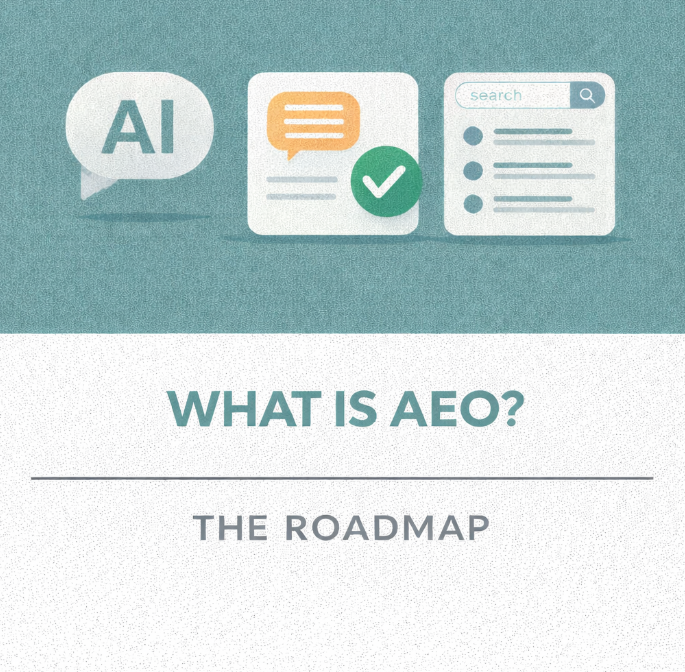
Search behaviour has changed. Instead of typing short keywords and browsing multiple websites, people increasingly ask full questions and expect immediate answers. They want clarity, not options.
This shift has given rise to Answer Engine Optimisation, commonly known as AEO. AEO focuses on helping your business appear when search platforms provide direct answers rather than a list of links. For Irish businesses, this matters because being visible at the answer stage builds trust earlier and shortens the decision-making process.
AEO stands for Answer Engine Optimisation.
Answer engines include search features and platforms that respond directly to questions. These include:
When someone asks a question like “How much does SEO cost in Ireland?” or “Is Google Ads worth it for small businesses?”, AEO determines whether your content is used to answer that question.
Traditional SEO focuses on rankings. AEO focuses on answers.
SEO aims to bring users to your website. AEO often delivers the answer before the user clicks anywhere. This does not reduce value. In many cases, it increases trust. When users see your business providing clear, helpful answers, they are more likely to choose you when they need a service. AEO prioritises clarity, structure and relevance over keyword density or volume.
Read More: How to Tell if Your SEO Was Actually Done Properly
Answer engines look for content that is:
Content that rambles, avoids the question or uses vague marketing language is less likely to be selected. This is why FAQs, guides and explanatory sections play such an important role in AEO.
Read More: Why are FAQs important for your website?
Many Irish SMEs rely on being trusted before being contacted, especially in industries like legal, finance, trades, healthcare and professional services. When your business appears as the source of an answer, you gain credibility instantly. You become part of the learning process rather than just another option.
AEO also helps smaller businesses compete. You do not need the biggest budget. You need the clearest explanation.
AEO-friendly content includes:
For example, a well-written FAQ answering “How long does SEO take?” can appear in search results, voice search answers and AI summaries simultaneously.
AEO does not replace SEO or GEO. It strengthens them.
SEO ensures your website is indexed and discoverable.
AEO ensures your content is selected as the answer.
GEO ensures AI tools reference your business correctly.
Together, they form a modern search strategy that reflects how people actually search today.
Read More: SEO, AEO and GEO Explained: Modern Search Optimisation for Irish Businesses
Some businesses think AEO means giving everything away for free. In reality, AEO builds trust and attracts more qualified enquiries. Others assume short answers are enough. In practice, answer engines favour clarity supported by context. AEO is not about oversimplifying. It is about removing confusion.
Any business that answers questions during the sales process can benefit from AEO.
If customers regularly ask about pricing, timelines, comparisons, risks or processes, those questions belong online in structured, optimised content. Businesses that proactively answer questions reduce friction and build authority.
The simplest way to start is to list the questions customers ask most often.
Then:
Over time, this content becomes one of your strongest visibility and trust assets.
If you want your business to appear when questions are asked, not just when keywords are typed, AEO should be part of your strategy. At The Roadmap, we help businesses structure content that works across traditional search, answer engines and AI platforms. You can explore our SEO and AEO services or request a checkup to see how well your current content performs in answer-driven search.
This is the most common concern for Irish SMEs. While AEO can lead to “Zero-Click” searches (where the user gets the answer without clicking), it actually improves the quality of the traffic you do get. If a user in Cork sees your business as the “Featured Snippet” answer for a complex question, you have already won the trust battle. When they finally do click or call, they are much closer to a “hot lead” than someone just browsing a list of links.
Google’s “People Also Ask” (PAA) boxes are a goldmine for AEO. To get there, you need to structure your content using the “Question-Answer” format. Use your H2 or H3 tags as the literal question (e.g., “How long does a roof repair take in Ireland?”) and follow it immediately with a concise, 40–60 word paragraph that directly answers it. At The Roadmap, we help businesses identify these high-value PAA opportunities specifically within the Irish search landscape.
Absolutely. Voice assistants are essentially “Answer Engines” without a screen. When someone asks their phone a question while driving, the assistant usually pulls the answer from the top-rated Featured Snippet. By optimising for AEO, you aren’t just ranking on a screen; you are becoming the “voice” of your industry for local customers who prefer hands-free search.
Yes. This is the “Great Equalizer” for Irish SMEs. Google doesn’t choose the biggest company for the “Answer” spot; it chooses the clearest and most authoritative answer. A small, local solicitor in Galway can outrank a massive national firm if their FAQ page provides a more direct, better-structured answer to a specific legal question. Speed and clarity beat a big budget in the world of AEO.
An FAQ page is a list of questions; AEO is the strategy of making those questions discoverable. AEO involves using “Schema Markup” (hidden code) to tell search engines exactly which part of your page is the question and which part is the answer. Without this technical layer, your great answers might stay hidden on your site instead of being pulled to the top of the search results.
Written by The Roadmap Strategy Team, helping Irish businesses earn trust by answering questions clearly wherever search happens.